Sintra · Lisboa
Palácio Nacional e Jardins de Queluz
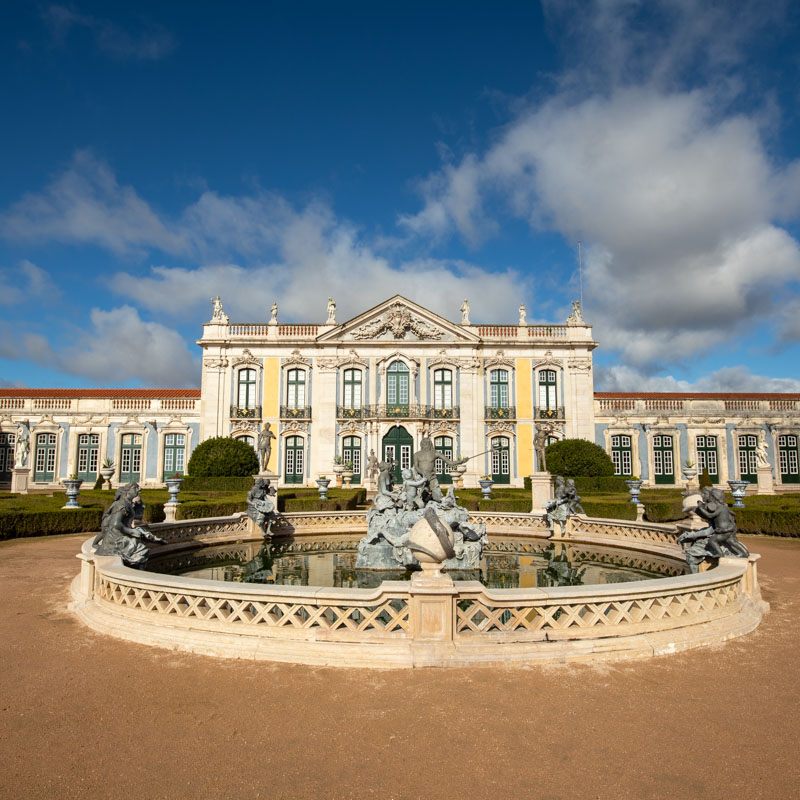
In Queluz, the Portuguese court still seems to breathe among luminous state rooms and gardens designed for pleasure. Born from a country house belonging to the Casa do Infantado, the palace was enlarged from 1747 for the infante D. Pedro, the future D. Pedro III, and under Jean-Baptiste Robillion it acquired the rococo elegance that still defines it today. After the fire at the Real Barraca da Ajuda in 1794, it became the official residence of Queen Maria I and the prince regents, until the royal family left for Brazil in 1807. Queluz also holds a rare emotion: D. Pedro IV was born and died here, in the famous Quarto D. Quixote. In the gardens, it is worth slowing down beside the parterres, the mythological sculpture and the Canal dos Azulejos, where the royal family once drifted by boat to the sound of music. Few places unite palatial intimacy, courtly theatre and the art of outdoor living with such grace.
Why it matters
The National Palace and Gardens of Queluz developed from the former country house of Queluz, which became part of the House of the Infantado in 1654. The great transformation began in 1747, when Infante Pedro, the future Pedro III, asked Mateus Vicente de Oliveira to enlarge the so-called Old Palace. From 1760 onwards, once the marriage of Pedro and Princess Maria had been announced, the project took on a new scale and came to involve Jean-Baptiste Robillion, who gave the ensemble the stature of a royal residence. After the fire at the Royal Barraca of Ajuda in 1794, Queluz became the official residence of Queen Maria I and later of João VI and Carlota Joaquina. The palace remained in permanent use until the royal family left for Brazil in 1807. In the nineteenth century it lost political centrality, yet kept a strong symbolic weight, also linked to Pedro IV, who was born and died there. Classified as a National Monument in 1910, it remains one of Portugal’s most expressive royal residences.
Architecture and history
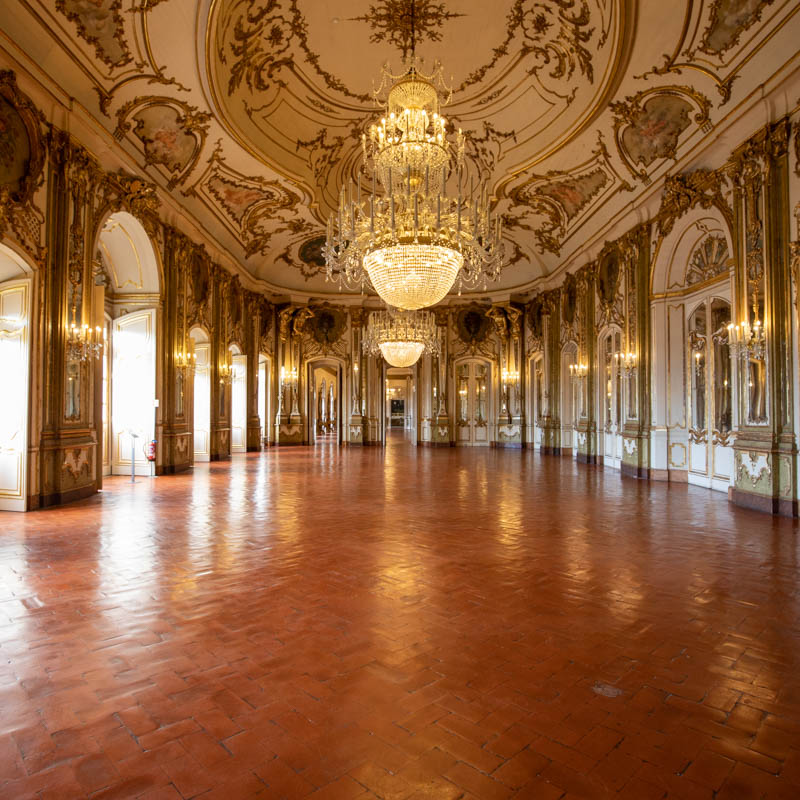
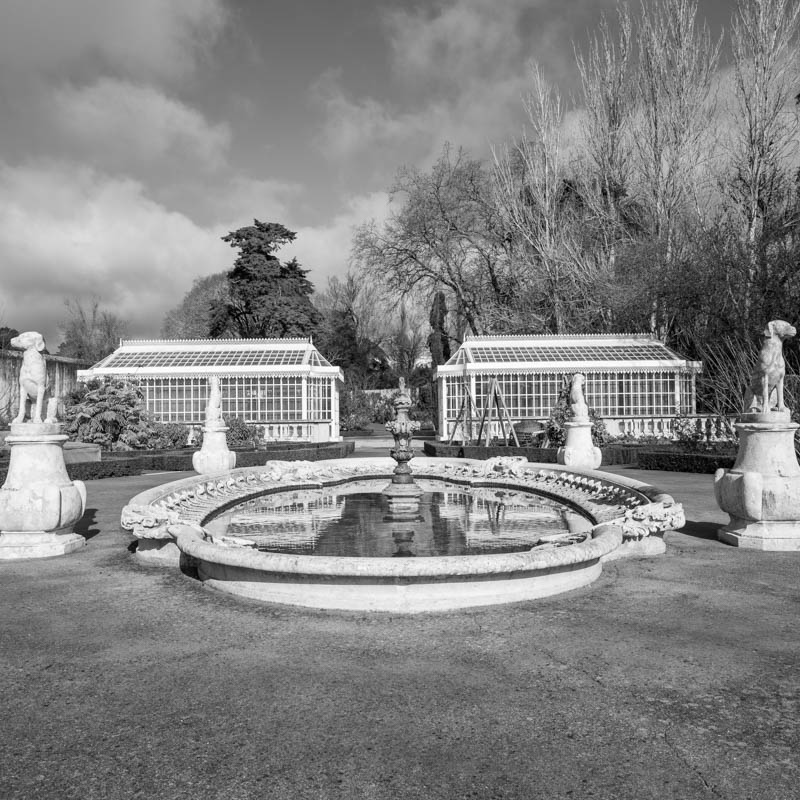
Queluz’s architecture results from successive building campaigns, yet it preserves a rare unity between palace and garden. Mateus Vicente defined essential parts such as the courtyard of honour and the ceremonial façade facing the gardens. Robillion later intensified the French rocaille taste, designed the Robillion Pavilion and the formal gardens, and closed the palace into a U-shaped plan that gives it a more intimate scale than many other royal residences. The ensemble moves through Baroque, Rococo and Neoclassical language, with a strong presence of gilded carving, mirrors, decorative painting, tiles and statuary. Among the most striking spaces are the Throne Room, with gilded woodwork, Atlases, mirrors and French windows opening onto the garden, the Music Room, almost unchanged since the 1761 inventory, and the Chapel, completed in 1752, with delicate gilded carving by Silvestre Faria Lobo. In the gardens, balustrades, sculpture, lakes and the Tile Canal extend the palace staging into the open air.
More context
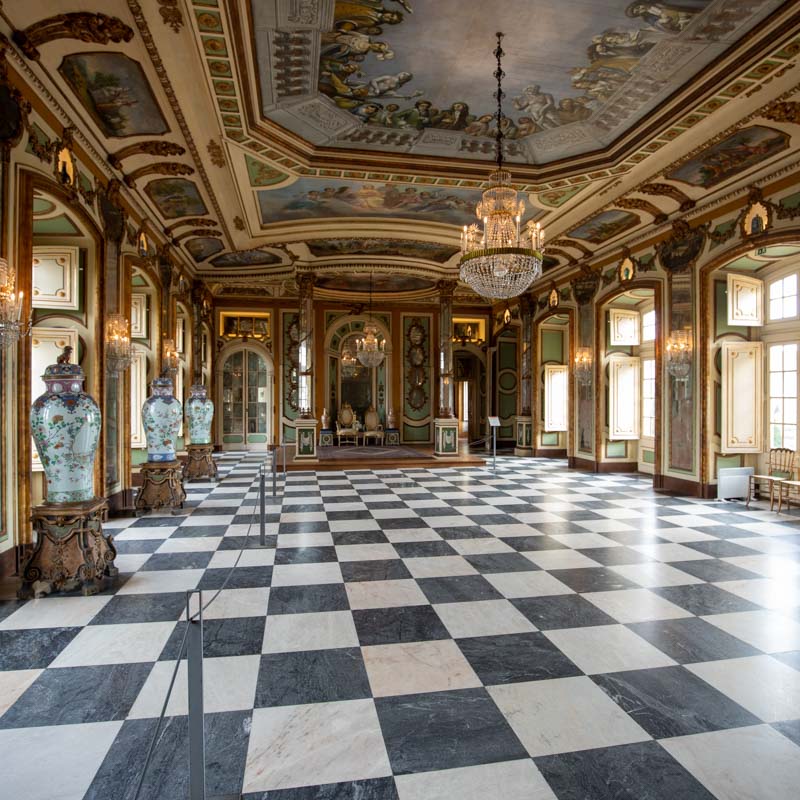
The Throne Room is one of the best places to understand the ceremonial use of Queluz. Its Rococo decoration, mirrors, Atlases and direct opening onto the garden show how festivity, representation and architecture worked together. Next to it, the Music Room preserves carved woodwork referring to musical instruments and a rare Clementi pianoforte that is still used in concerts. The Ambassadors’ Room deserves attention for its central ceiling painting, its thrones and the large Chinese porcelain vases set on gilded stands, all signs of the audience and hand-kissing protocol in the time of João VI. In the Robillion Pavilion, the Don Quixote Room stands out for the false circular effect created by its eight columns and for the fact that Pedro IV was both born and died there. Outside, the 115-metre Tile Canal and the Upper Gardens help explain the relationship between perspective, water, stairways and statuary. The visit becomes even richer with the Chapel and the Corridor of Tiles.
Gallery