
Sé do Porto

Porto · Porto

Sé do Porto

ChurchXIIReligious Architecture
Terreiro da Sé, 4050-573 Porto4.6 Rating · 37,03260 min

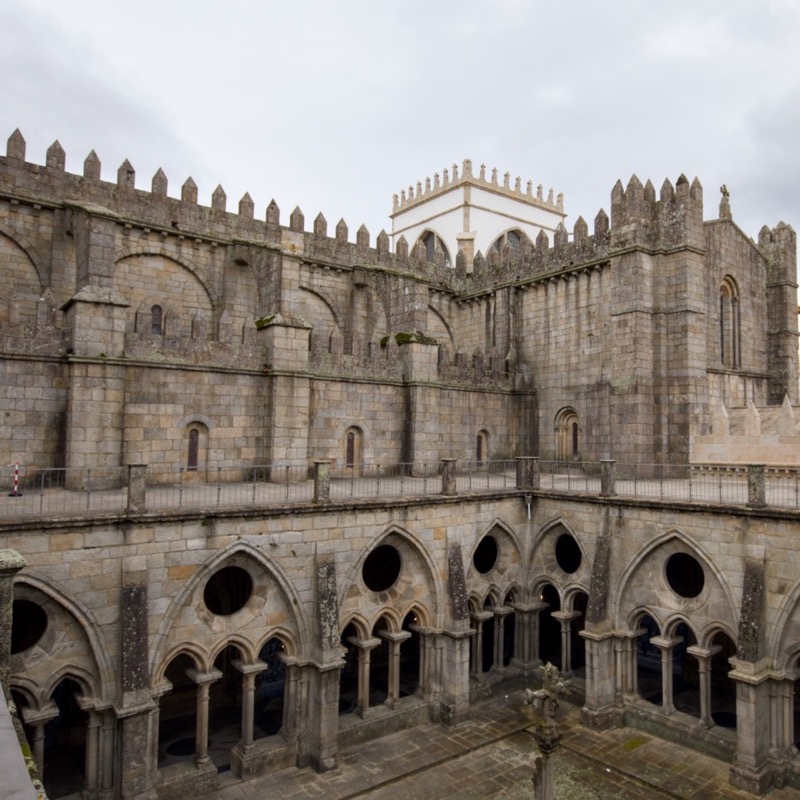
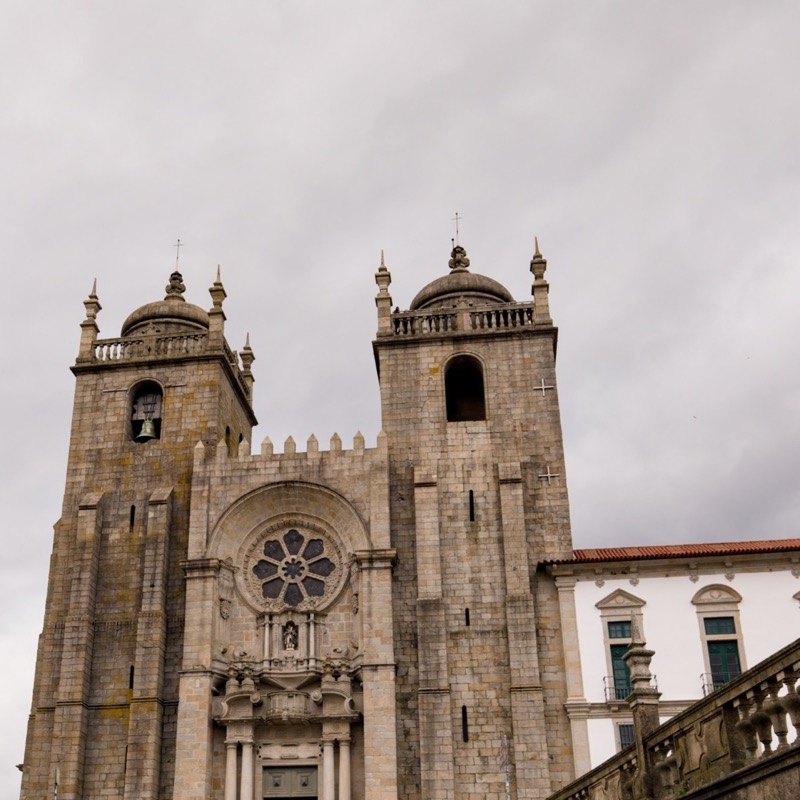
Porto Cathedral rises on the Terreiro da Sé, in the historic heart of the city, as a Romanesque-Gothic cathedral marked by successive transformations. Classified as a National Monument in 1910, it preserves traces of the Romanesque building begun in the first half of the 12th century and continued until the early 13th century. Its fortress-church silhouette, with a façade flanked by two towers, battlements and a rose window, reveals the austere strength of the medieval construction. The building received Mannerist and Baroque alterations, among them the lateral galilee of 1736, by Nicolau Nasoni, facing the city. The Gothic cloister, associated with the time of King João I, contains 18th-century tile panels. Between ancient stone, gilded woodcarving and open views over Porto, the Cathedral shows the city’s religious, artistic and urban continuity.

Why it matters

Porto Cathedral stands on the hill of Pena Ventosa, the highest point of the historic centre, beside the line of the medieval city walls and with direct views over the River Douro. Construction of the present cathedral began in the first half of the 12th century, under Bishop Dom Hugo, and continued until the early 13th century. The first building, in Romanesque style, already displayed the character of a fortress-church, with a massive facade flanked by two towers and a rose window above the portal, as well as the three-aisled body of the church covered by a barrel vault. As the town of Porto developed, the cathedral asserted itself as the main church of the diocese and the religious centre of the city. In the Gothic period, between the late 14th and early 15th centuries, the cathedral was enlarged with key elements: the construction of the cloister, with a quadrangular plan and ribbed vaulting, and the opening of new funerary chapels, such as that of João Gordo, a knight of the Hospitaller Order. It was also here that, in 1387, the marriage of King João I and Philippa of Lancaster was celebrated, a symbolic episode of the new Avis dynasty. Between the 17th and 18th centuries the cathedral underwent major Baroque remodelling. The original Romanesque apse was replaced by a larger main chapel, with a Joanine Baroque gilded altarpiece and mural paintings attributed to Nicolau Nasoni. The exterior gained the lateral loggia overlooking the city, designed by Nasoni in 1736, as well as new domes and balustrades on the towers and a Baroque portal replacing the Romanesque one. In 1910 Porto Cathedral was classified as a National Monument and today forms part of the core of Porto’s Historic Centre recognised by UNESCO.

Architecture and history

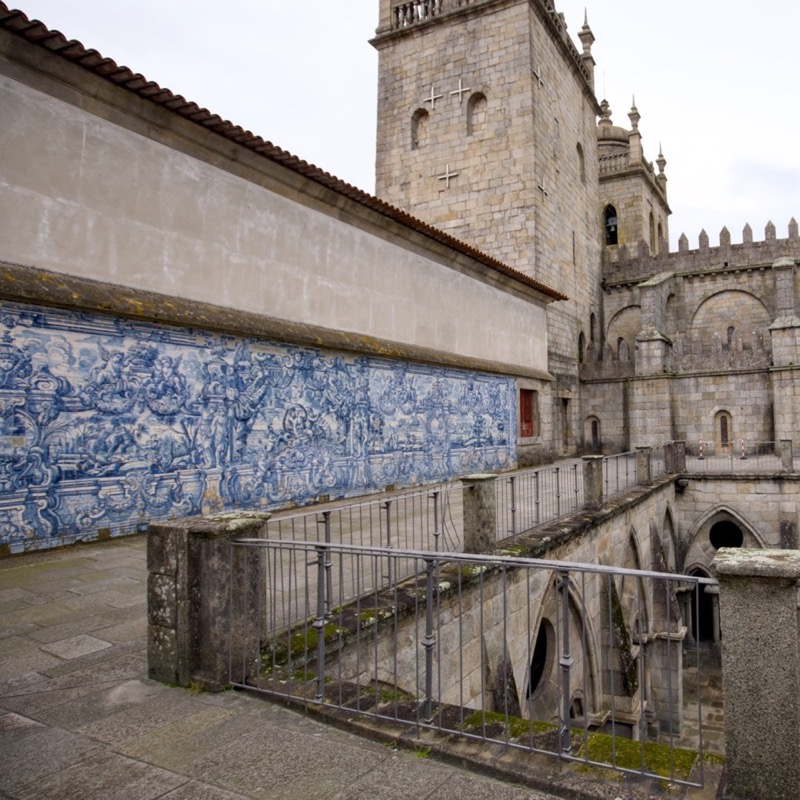
Porto Cathedral is a Romanesque-Gothic structure with a Latin-cross ground plan composed of three stepped naves, a prominent transept and a deep chancel. The main facade consists of a central body framed by two square towers crowned with Baroque domes and balustrades, above a portal preceded by a symmetrical staircase. At the centre stands the rose window, opened in the 12th/14th centuries, which lights the nave. The ensemble still preserves the appearance of a fortress-church, with compact granite volumes, marked buttresses, narrow openings and battlements, reinforcing the defensive image of the building. Inside, the central nave is covered by a barrel vault supported on pointed arches and flying buttresses, while the lower side aisles are articulated by massive piers. The Mannerist-Baroque main chapel features an 18th-century gilded altarpiece, flanked by chapter stalls and two historic organs. In the transept, much-venerated images such as Our Lady of Vandoma, patron saint of the city, and Our Lady da Silva are displayed in richly decorated Baroque chapels. The Blessed Sacrament Chapel, with its large silver altarpiece executed between the 17th and 19th centuries, is one of the masterpieces of Portuguese goldsmithing. On the south side of the church lies the Gothic cloister, begun in the late 14th century, with vaulted galleries and pointed arches around a central courtyard. The walls are clad with large blue-and-white tile panels from the 18th century, attributed to Valentim de Almeida, depicting scenes from the Song of Songs and episodes from the life of the Virgin Mary. A noble Baroque staircase, designed by Nasoni, leads to the upper floor, where a terrace also decorated with tiles of pastoral and mythological themes gives access to the Chapter House and Treasury in the Casa do Cabido, housing collections of sculpture, silverware and liturgical vestments.

More context

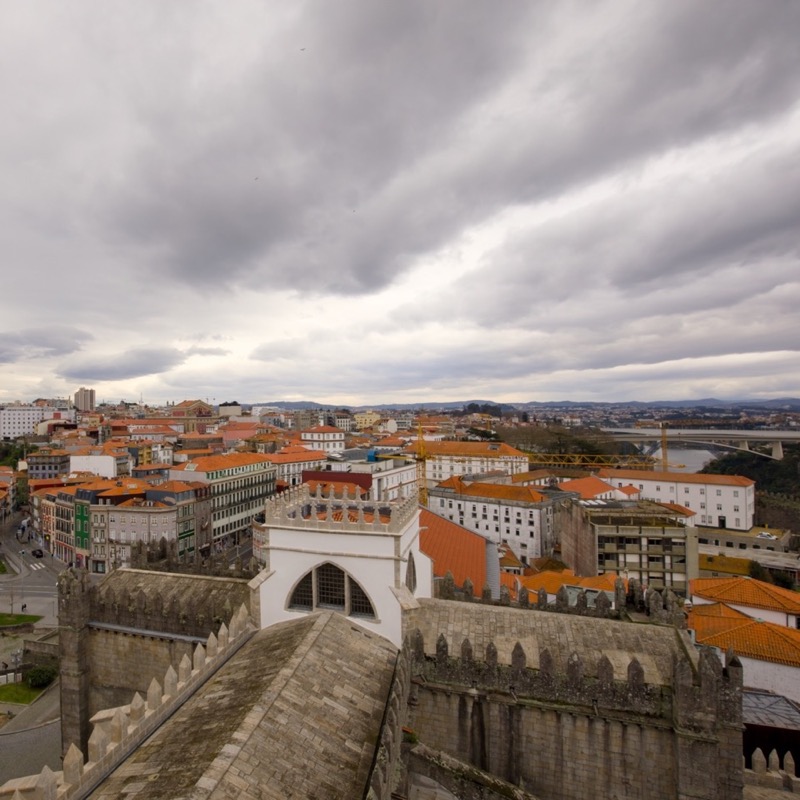
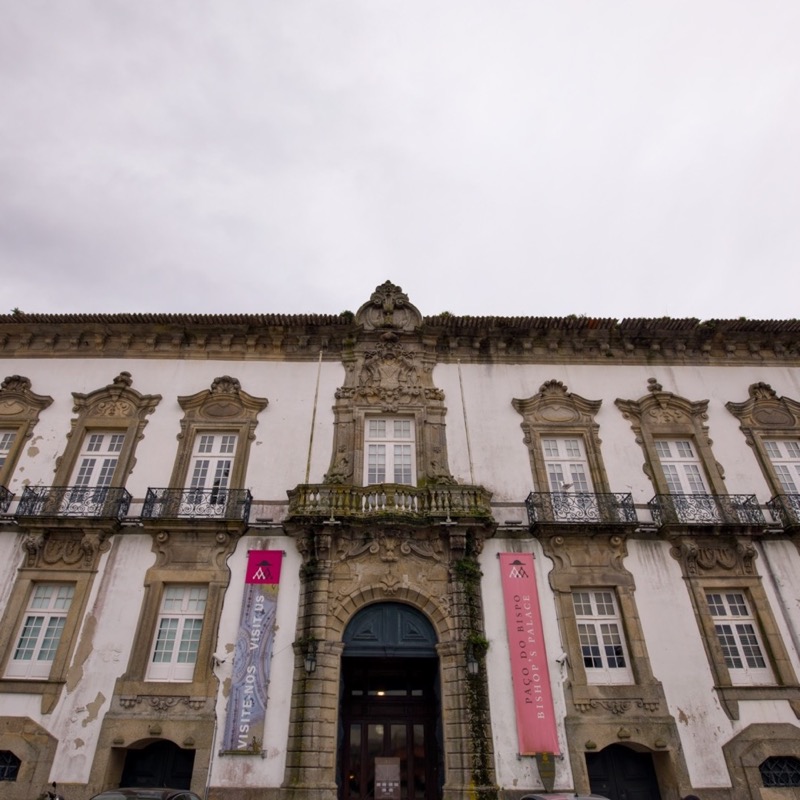
A visit to Porto Cathedral usually begins in the Terreiro da Sé, the broad forecourt overlooking the Ribeira district. From here you can take in the main facade with its twin towers, the granite pillory, the statue of Vímara Peres and the surviving stretches of the old city wall, as well as the nearby Episcopal Palace. This exterior space helps to understand the cathedral’s strategic position in the medieval fabric and its relationship with the urban ensemble classified as a World Heritage Site. Inside, it is worth walking along the central nave towards the main chapel, noting the rose window, the sequence of arches and the different artistic periods present. The main chapel, with its Joanine gilded altarpiece and Baroque mural paintings, contrasts with the Romanesque austerity of the church body. In the transept, attention is drawn to the images of Our Lady of Vandoma and Our Lady da Silva, and to the side chapels decorated with carving and painting. The Blessed Sacrament Chapel, with its large silver altar, is a highlight of the visit in both artistic and liturgical terms. The high choir, with a modern organ and a view over the nave, completes the reading of the interior space. Access to the cloister is from the south side of the transept. Visitors can walk through the four Gothic galleries, observing the interplay between medieval architecture and Baroque tile decoration, and visit the adjoining chapels and rooms where sculptural elements and historic tombs are preserved. Nasoni’s staircase leads to the upper floor, taking you to the Casa do Cabido and the cathedral Treasury, which displays silverwork, liturgical books and vestments. From the upper terrace and the openings onto the exterior there are exceptional views over the Douro, the Luís I bridge and the Ribeira quarter. The cathedral is also a stopping point for pilgrims on the Portuguese Way of St James, acting as a symbolic gateway into Porto’s historic heart.

Routes

Explore this place in a cultural route

View all Routes

Gallery

Sé do Porto 1
Sé do Porto 2
Sé do Porto 3
Sé do Porto 4
Sé do Porto 5

Nearby places

View all