Cascais · Lisboa
Casa Sommer
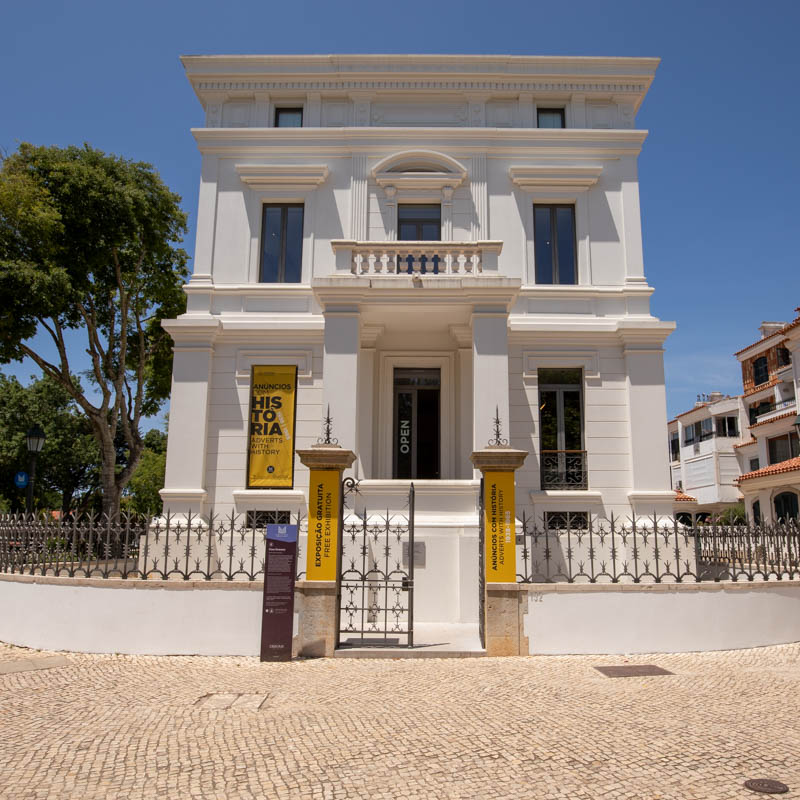
In Cascais, Casa Sommer reveals a side of the town that is less maritime and more urban, shaped by the elegance of the late nineteenth century. Commissioned by Henrique Sommer, this Neoclassical house with a square plan is described by the municipality as the most refined example of a private residence of its kind in Cascais, with symmetrical façades, pilasters, pediments and a noble balcony that give it an almost palatial dignity. For decades it remained a private home; later, it fell into neglect, until a major rehabilitation restored it, also incorporating the former stables and a new underground structure. Since 2016, it has housed the Municipal Historical Archive and the Municipal Bookshop, becoming not just a recovered building but a true centre of local memory. That transformation is what strikes most deeply: a house once meant to express social standing now preserves documents, stories and traces of centuries of municipal life, as if the architecture had found a second vocation in time itself.
Why it matters
Casa Sommer helps visitors understand late 19th-century Cascais, when the town was becoming established as a place of summer residence for wealthy families. The house was commissioned by Henrique Sommer, a businessman connected with the iron trade and later associated with the development of the cement industry in Portugal. For decades, it remained linked to the family that gave it its name. In the early 1980s, it was used by the municipality as the Culture and Sports Centre for City Council staff, followed by a period of abandonment. The rehabilitation of the building, with a project by architect Paula Santos, gave it a new public function. Since 7 December 2016, it has housed the Cascais Municipal Historical Archive and Municipal Bookshop. In this way, a former private residence became a house for the documentary memory of the municipality.
Architecture and history
The quadrangular plan gives the building a compact, almost cubic presence, reinforced by the raised ground floor in relation to the street. Cascais City Council describes Casa Sommer as the most important example of a private Neoclassical residence in the town. On the façades, the classical language appears in plain and curved pediments, fluted pilasters, cartouches, mouldings, friezes and triglyphs. The south façade concentrates the main entrance: a rectangular portico resting on pillars frames the door and supports the noble balcony of the second floor, protected by a stone balustrade. The floors are marked by projecting friezes, and the ground floor is distinguished by rusticated masonry. To the north, the former coach houses, designed by Francisco A. de Magalhães, complete the ensemble and recall the functional organisation of a manor house.
More context
The south façade is the best point from which to understand the representative intention of the house: notice the portico, the balcony, the symmetry of the openings and the way the classical ornaments give order to the whole. The side façades repeat similar rhythms, reinforcing the idea of a regular and controlled volume. Also observe the difference between the main house and the former coach houses, as this relationship shows the separation between noble spaces and support areas. Inside, the contemporary adaptation reveals another layer of history: the building stopped serving private life and began to preserve documents essential for studying Cascais. The new underground body, created during the rehabilitation, links the house to the coach houses without erasing the reading of the two buildings. The Municipal Bookshop adds a visible dimension to this role of memory, through publications on local history, heritage and culture.
Gallery