Lisboa · Lisboa
Palácio Nacional da Ajuda
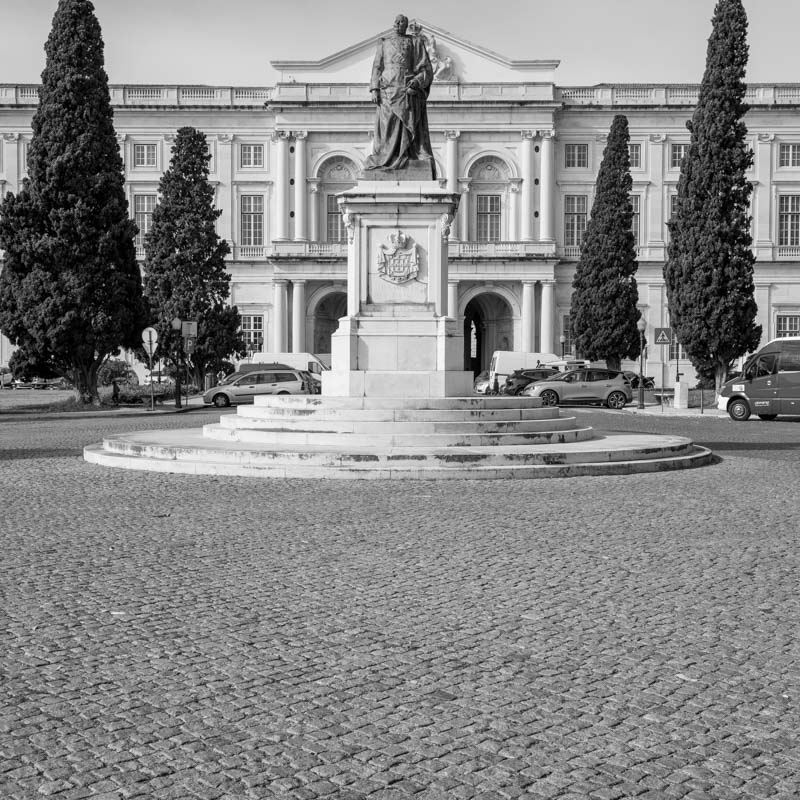
High on Ajuda hill, this neoclassical palace speaks less of completed triumph than of ambition, interruption and endurance. Conceived at the start of the nineteenth century to replace the wooden Real Barraca built after the earthquake, it was never fully finished, held back by the court’s departure to Brazil and by repeated financial difficulties. Even so, it became the royal family’s official residence from the reign of King Luís the First, and it was under Queen Maria Pia that it gained the domestic and ceremonial brilliance still felt in its interiors today. During a visit, it is worth lingering in the Throne Room, the state salons and the private apartments, because few places in Lisbon preserve so authentically the taste and protocol of nineteenth-century court life. Between its view over the Tagus, its splendour and its intimacy, Ajuda National Palace leaves the rare impression of a royal home suspended in time, made even more compelling by the fact that it was never entirely completed.
Why it matters
The Ajuda National Palace stands on the hill that received the court after the 1755 earthquake, when King José I chose to settle in the Real Barraca, a wooden residence built in the area. After the fire of 1794 destroyed that provisional palace, a new royal residence became urgent. The project that defined the present building dates from 1802, under the regency of Prince João, later King João VI, and was entrusted to Francisco Xavier Fabri and José da Costa e Silva, following an earlier phase associated with Manuel Caetano de Sousa. Work progressed slowly and the palace was never completed according to its first ambition, largely because of financial difficulties and the departure of the royal family to Brazil in 1807. Still unfinished, it was already receiving court ceremonies when the royal household returned in 1821. It became the main residence of the royal family during the reign of King Luís I, from 1861 onwards, and gained new decorative life with Queen Maria Pia. After 1910 it was closed and, since 1968, it has functioned as a museum, preserving the memory of Portugal’s constitutional monarchy.
Architecture and history
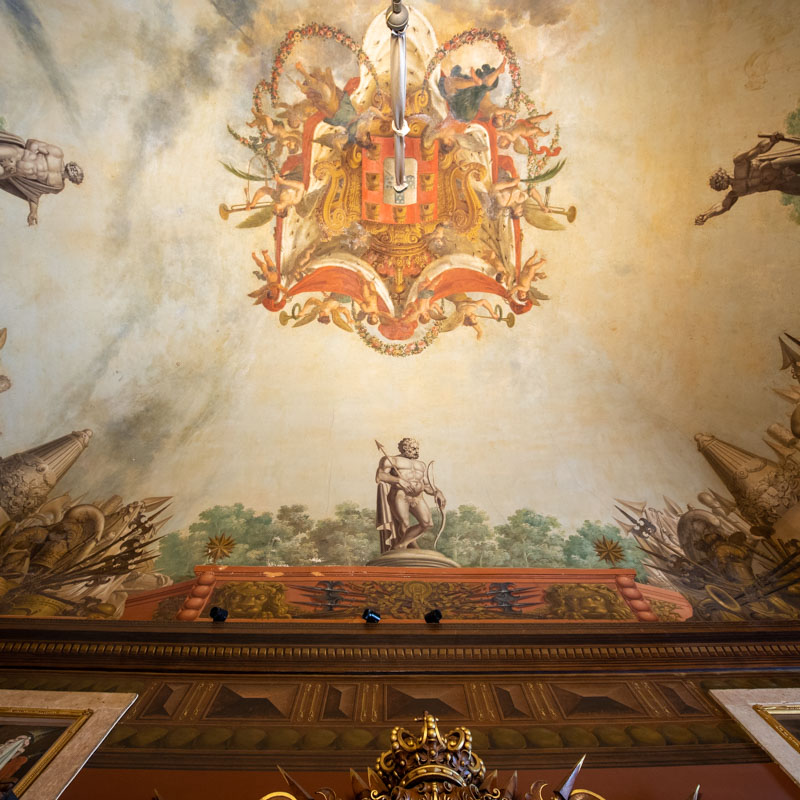
Architecturally, the palace is a major neoclassical work from the first half of the nineteenth century. It was conceived on the scale of the great European royal residences, yet it ended up reduced and unfinished, something that can still be felt in the austere composition of the whole and in the restrained monumentality of its façades. Its classical language organises the volumes with great regularity and gives the building a solemn presence above the Ajuda hill. Inside, however, the exterior sobriety gives way to a sequence of richly decorated rooms in which architecture, painting, sculpture and the decorative arts work together. On the ground floor, ceremonial rooms lead towards the private apartments arranged along the western front. The noble floor, by contrast, was reserved for gala receptions, balls and court banquets. Some of the leading artists of the period took part in the decorative programmes, including Domingos Sequeira, Arcângelo Foschini, Cirilo Volkmar Machado, Machado de Castro and João José de Aguiar. This link between building, ceremonial purpose and decoration makes Ajuda Palace a rare witness to nineteenth-century court culture in Lisbon.
More context
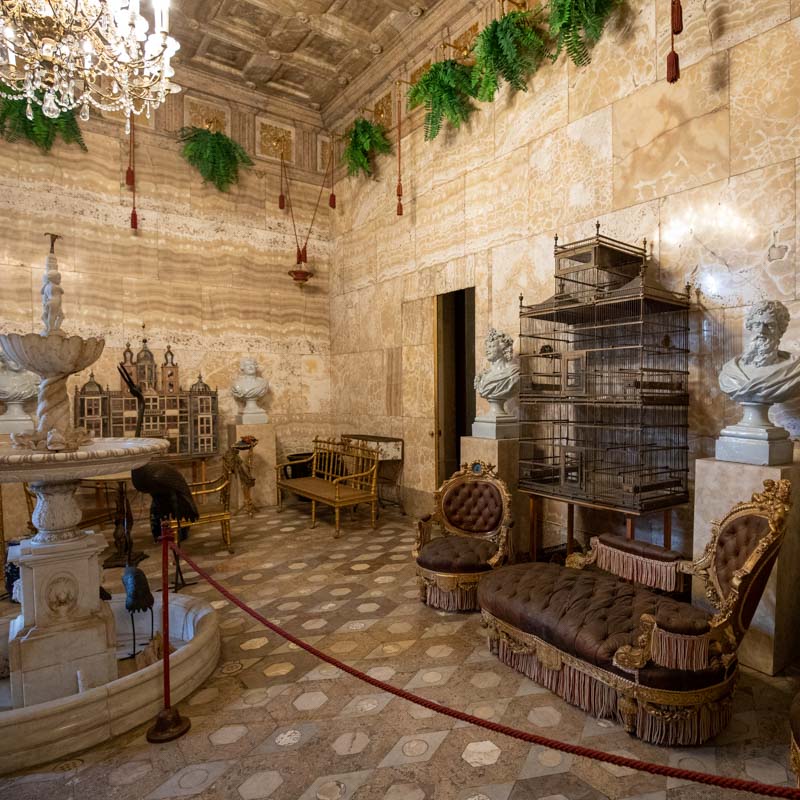
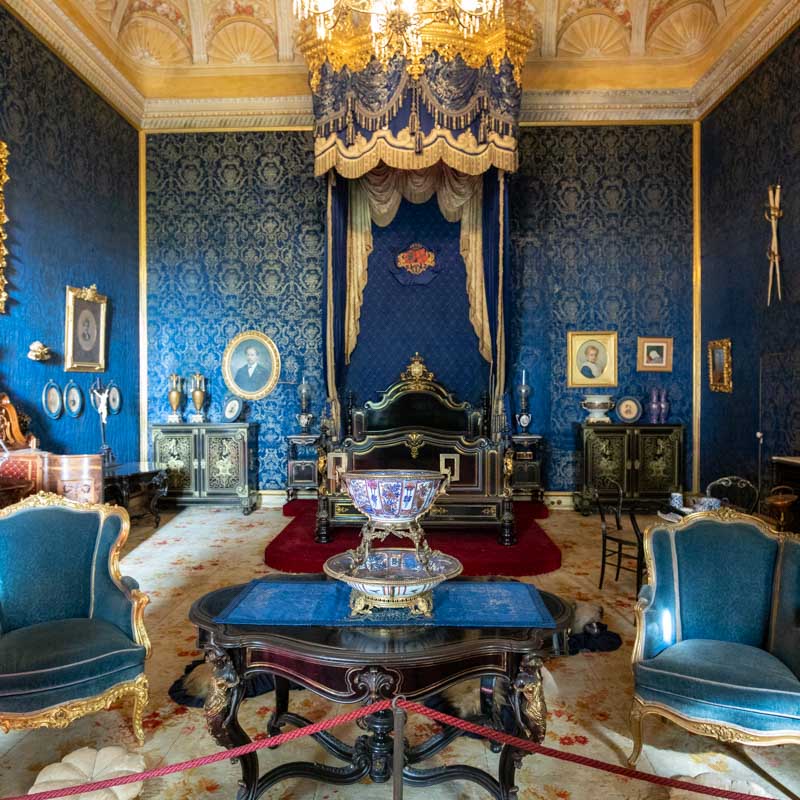
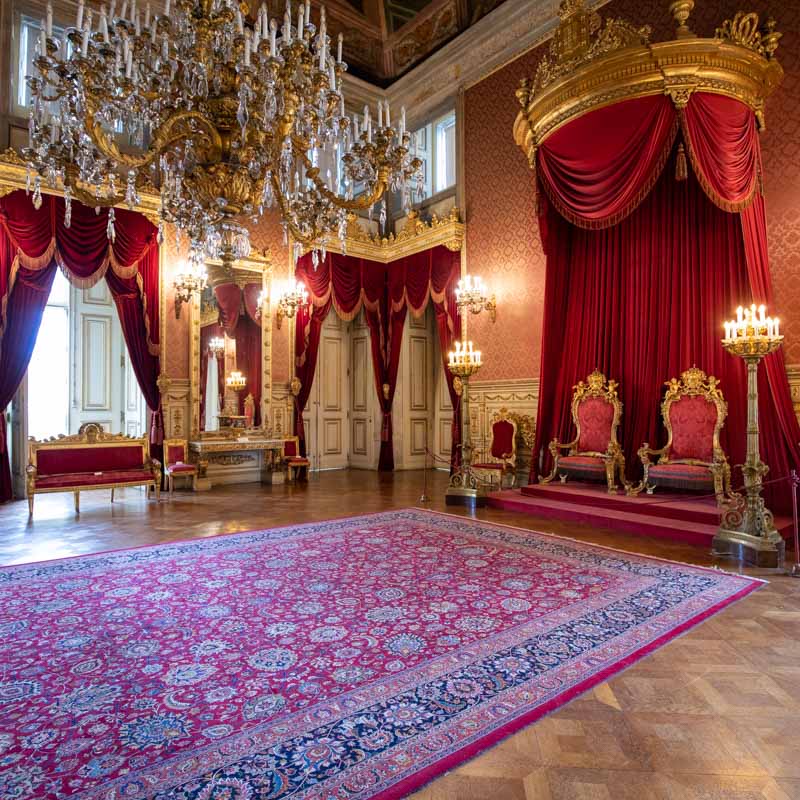
During a visit, the essential experience is to move through the rooms that still preserve the arrangement and atmosphere of the royal residence. The Throne Room is one of the key stops, because for a long time it was a space of high representation and of the Beija-Mão ceremony. The Great Dining Room helps visitors imagine the great court banquets, with monumental mirrors, table services and a strong sense of ceremony. The everyday Dining Room, more intimate in character, reveals another side of royal life, while the Marble Room shows the nineteenth-century taste for winter gardens and theatrical interiors. It is also worth paying attention to the Music Room, the Blue Room, the Queen’s Bedroom and the former rooms of the king, because the route makes clear how public and private spaces were articulated within the palace. Throughout the visit, the collections of furniture, tapestries, ceramics, glass, painting and silverwork help one read the building not only as a political setting, but as a lived-in house. That is what makes Ajuda National Palace such a revealing place for understanding court life in Lisbon.
Gallery