Lisboa · Lisboa
Panteão Nacional
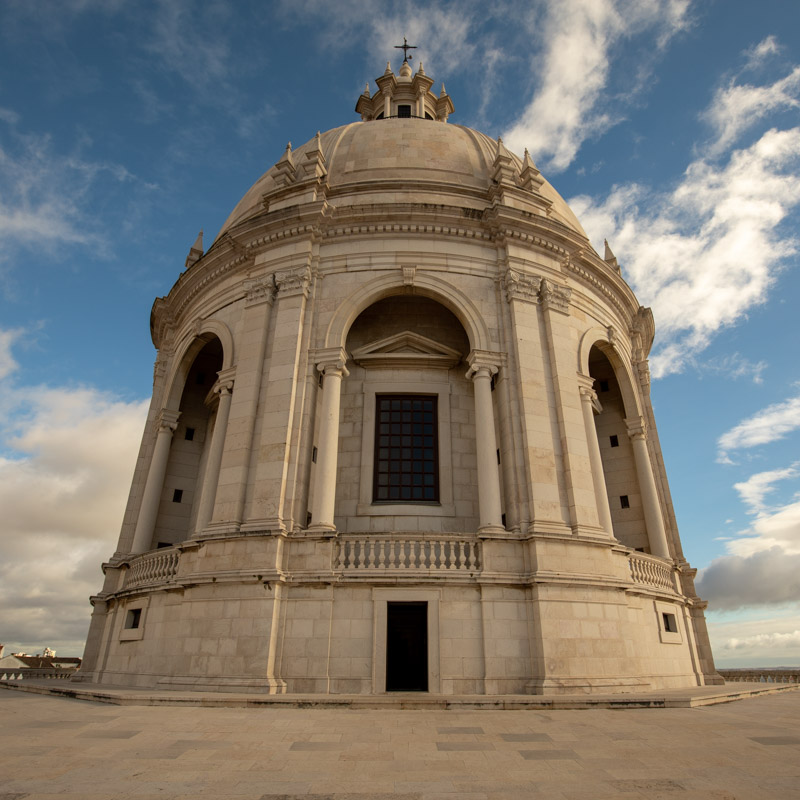
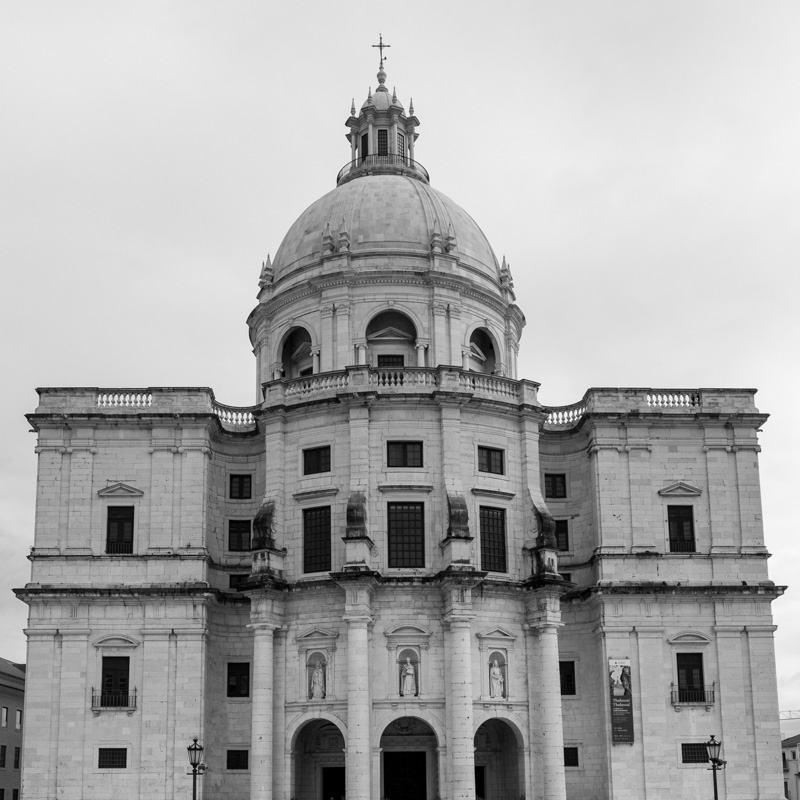
High above Santa Clara, the National Pantheon stands over Lisbon like a monument of stone memory. The building was originally intended to be the church of Santa Engrácia and began to rise in the late seventeenth century, to a design by João Antunes, but it took so long to be completed that it gave rise to the famous Portuguese expression “works of Santa Engrácia”, used for something that never seems to end. Only in the twentieth century was it adapted into the National Pantheon and finally completed, with its great dome and restored interior. Today, among coloured marbles, curved walls and a central space of striking scale, it honours major figures of Portuguese history and culture, including Almeida Garrett, Sophia de Mello Breyner Andresen and Amália Rodrigues. It is well worth climbing to the terrace, where the view over Alfama, the Tagus and Lisbon’s rooftops shows why this place feels both solemn and open to the city.
Why it matters
The history of the National Pantheon begins before the present building. In 1568, Infanta Maria obtained permission to create the parish of Santa Engrácia in Campo de Santa Clara, and a few years later work began on the first church. That temple underwent changes, suffered a profanation episode in 1630 and saw repair works, until the chancel collapsed during the storm of 1681. The Brotherhood of the Slaves of the Blessed Sacrament then decided to build an entirely new church, choosing the design by João Antunes. The first stone was laid on 31 August 1682, but the works dragged on for centuries and eventually gave rise to the popular expression works of Santa Engrácia, used for something that never seems to end. Throughout the eighteenth century, construction progressed slowly and remained incomplete. In 1910, the church was classified as a National Monument. Soon afterwards, the law of 26 April 1916 established its adaptation as the National Pantheon. The completion works began in 1960, and the monument was finally inaugurated in 1966.
Architecture and history
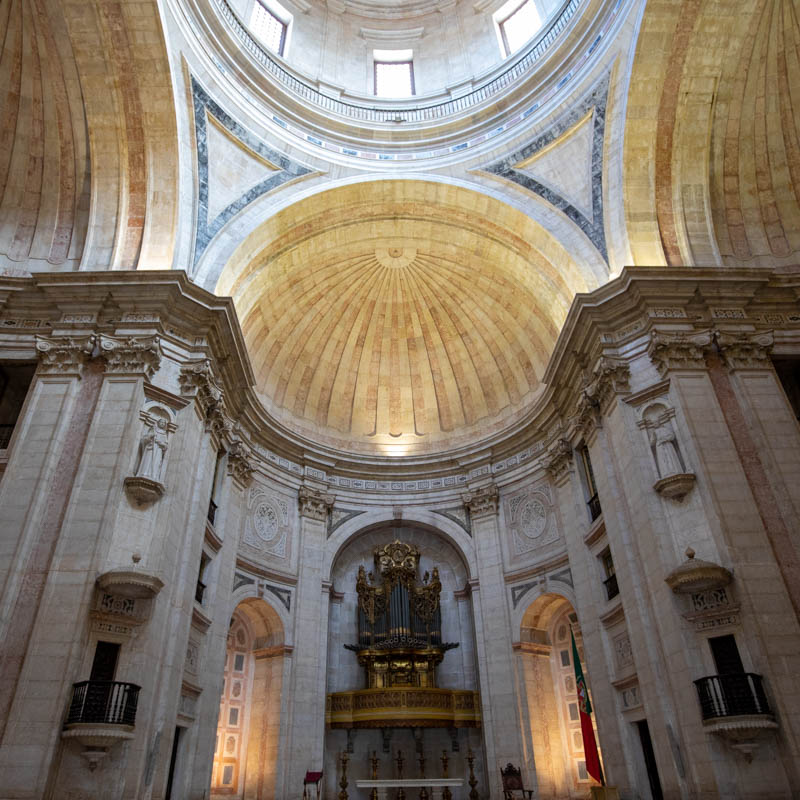
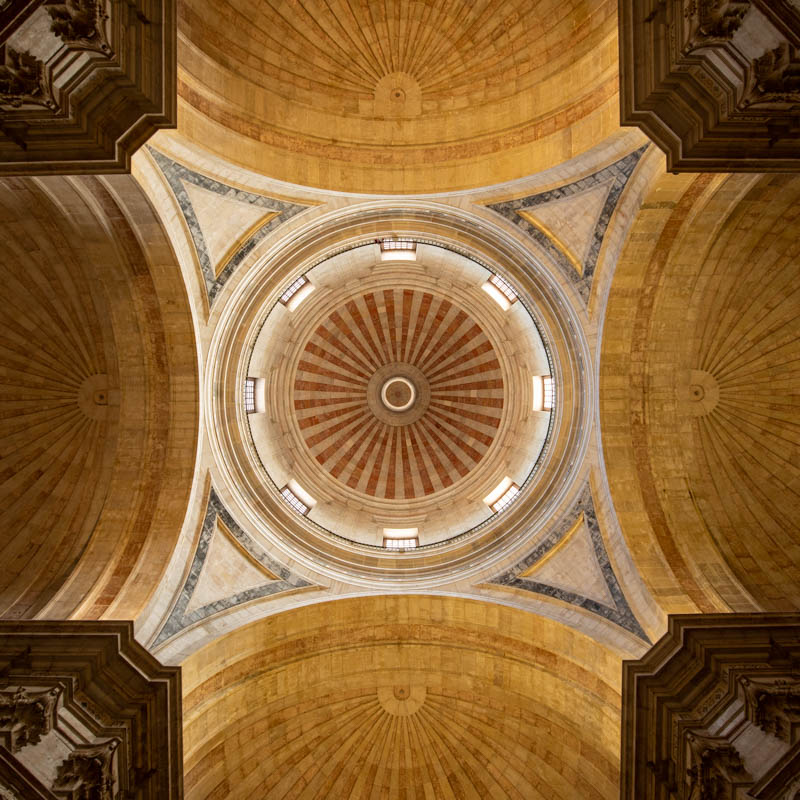
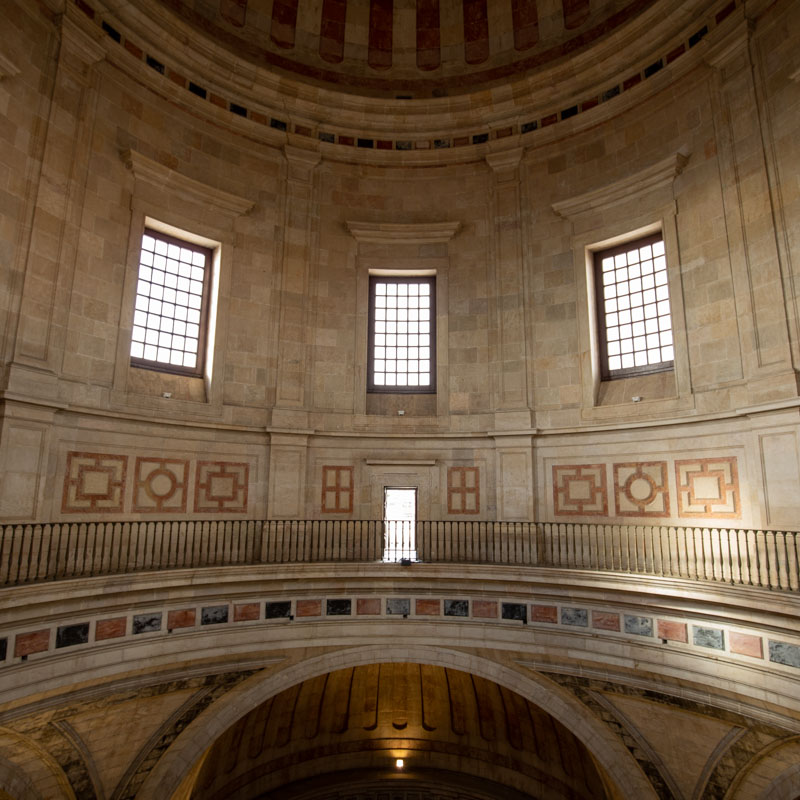
The architectural distinctiveness of the National Pantheon lies in its blend of Baroque monumentality and a centralised plan, something very rare in seventeenth-century Portugal. The building is arranged in the form of a Greek cross, with four equal arms linked on the outside by undulating walls and marked at the corners by turret-like volumes. Inspired by Italian models, this composition broke with Portuguese practice of the period and gave the former church of Santa Engrácia a striking profile in Lisbon’s skyline. The main façade, facing Campo de Santa Clara, brings together three portals beneath a galilee porch and includes a highly elaborate decorative programme attributed to the sculptor Claude Laprade. Inside, the central space stands out for its scale, geometric clarity and coloured marble decoration, one of the strongest features of Portuguese Baroque. The dome seen today, built between 1964 and 1966 in concrete clad with lioz stone, raised the monument to about 80 metres in height. The terrace, at 40 metres, strengthens the link between architecture, hillside and river.
More context
The tomb rooms in the four corners are among the most revealing parts of the monument, because they show how the former church was turned into a place of national memory. They contain the tombs of presidents of the Republic, writers, a fado singer, a military figure, a footballer and other honoured personalities, while the central nave holds six cenotaphs dedicated to names such as Luís de Camões, Vasco da Gama and Prince Henry the Navigator. It is worth looking upwards to grasp the sequence between the arms of the Greek cross, the semi-domes and the great central dome, and to notice the undulating walls that make this interior unusual. From the upper choir, the view across the nave helps explain the spatial organisation and allows a closer look at the eighteenth-century historic organ brought from Lisbon Cathedral. The interpretation centre adds context through elements from the earlier church, pieces of silverwork and models from the final building campaigns. On the terrace, the view over Alfama, Santa Clara, the Tagus and the city completes the understanding of the monument.
Gallery