Lisboa · Lisboa
Praça Dom Pedro IV
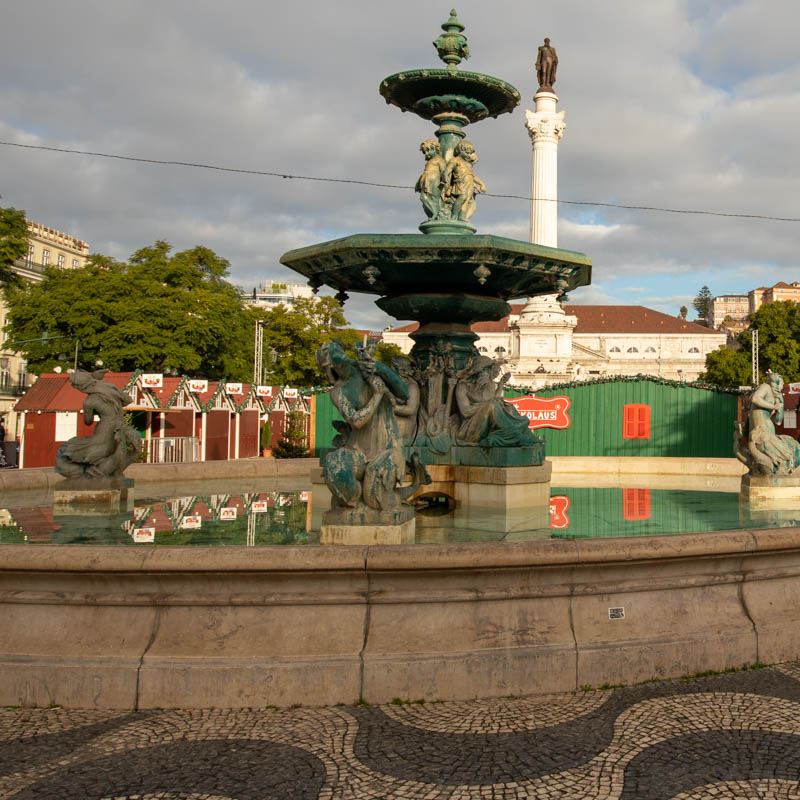
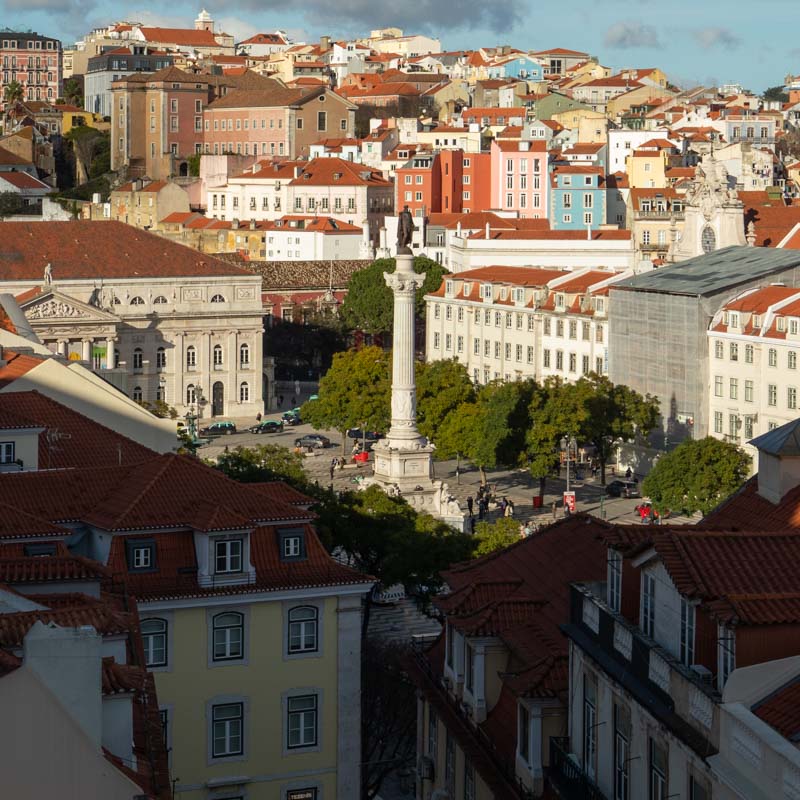
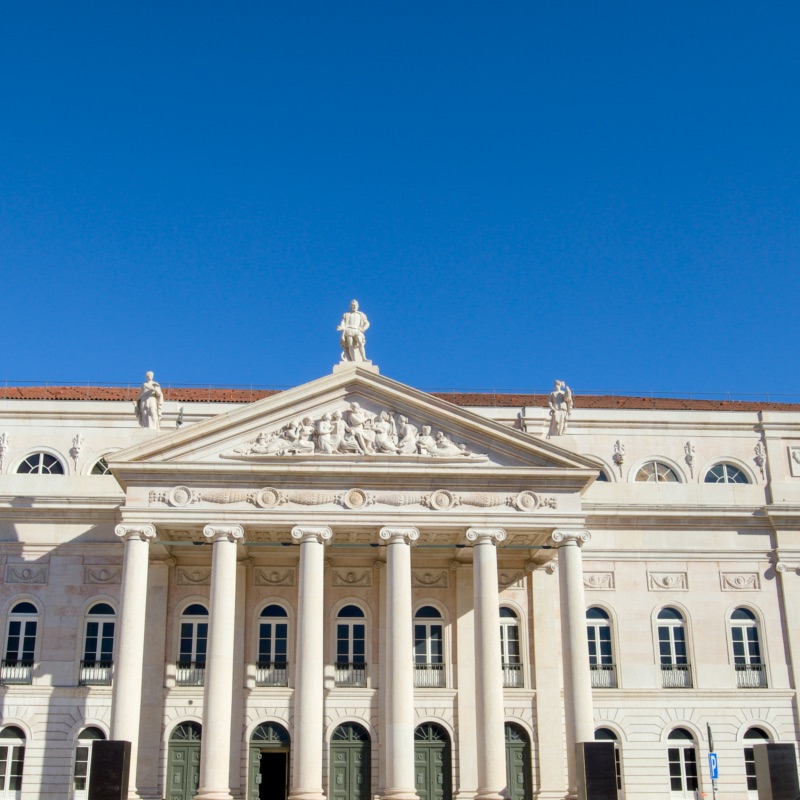
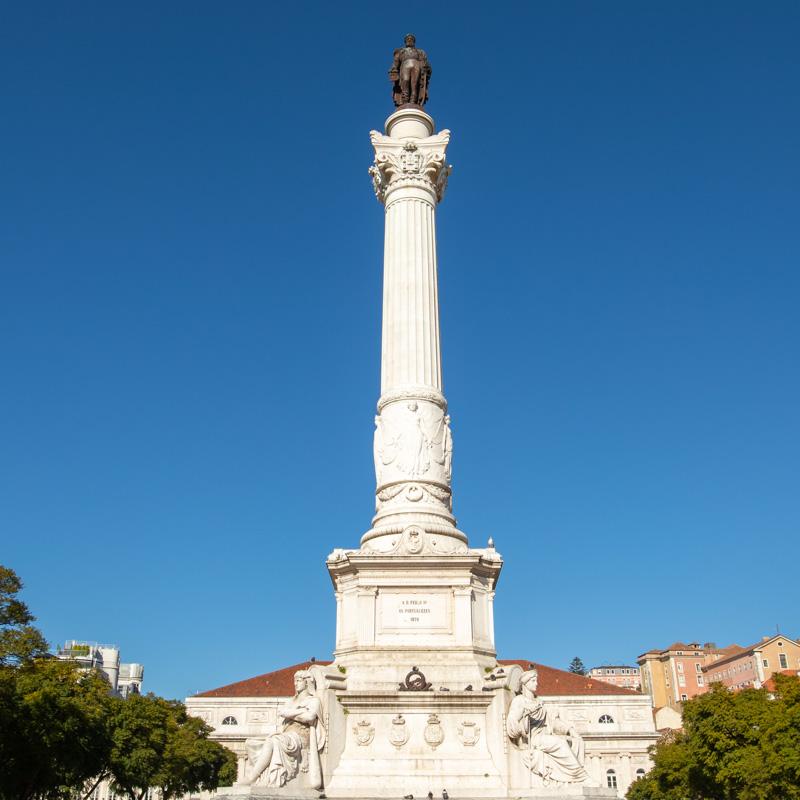
Few places sum up Lisbon’s public life as well as Praça Dom Pedro IV, which everyone still calls Rossio. For centuries it was a market, a stage for festivities, conspiracies and everyday encounters; after the earthquake of 1755, it took on the ordered shape that still structures the Baixa today. At its centre rises, since 1870, the column of D. Pedro IV holding the Constitutional Charter, as if the whole square were also a civic theatre. It is worth looking down at the pavement: the undulating pattern of the calçada, the “wide sea” of light and dark stone, has become one of Lisbon’s most recognisable images. There is also an almost invisible detail that makes the place even more fascinating: beneath Rossio, remains of the Roman circus of Olisipo have been identified. Between the murmur of cafés, the façade of the National Theatre and the flow of passers-by, this square remains an urban heart where Lisbon appears both ancient and vividly alive.
Why it matters
Known for centuries as Rossio, the present-day Praça Dom Pedro IV was, in the Middle Ages, an open space near one of Lisbon’s landward entrances, a zone of contact between city and countryside and a favoured place for fairs and markets. The Feira da Ladra occupied the southern side of the square from 1430 until the third quarter of the eighteenth century, and the area also hosted street trading, bullfights and autos-da-fé. Around it stood buildings that were central to Lisbon’s life, such as the Royal Hospital of All Saints, founded by João II in 1492 on the eastern side, and the Palácio dos Estaus, built in 1449 at the northern end and later linked to the Inquisition. The 1755 earthquake and the fire that followed destroyed or severely damaged that setting, leading to the enlargement and ordering of the square in Pombaline Lisbon. In 1836, Rossio officially received the name Praça D. Pedro IV, and in 1870 the central monument to the king was inaugurated.
Architecture and history
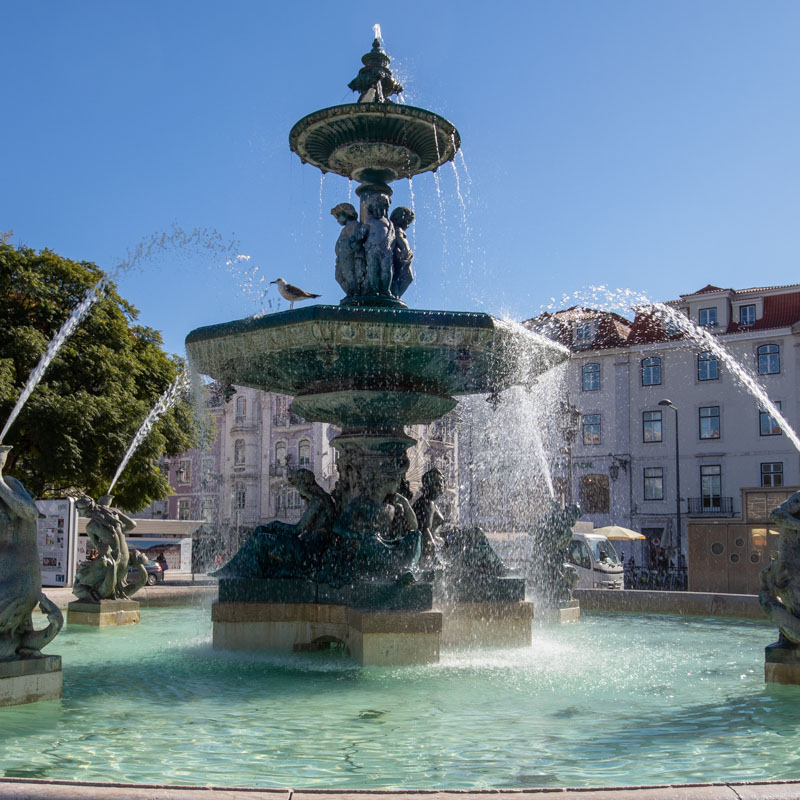
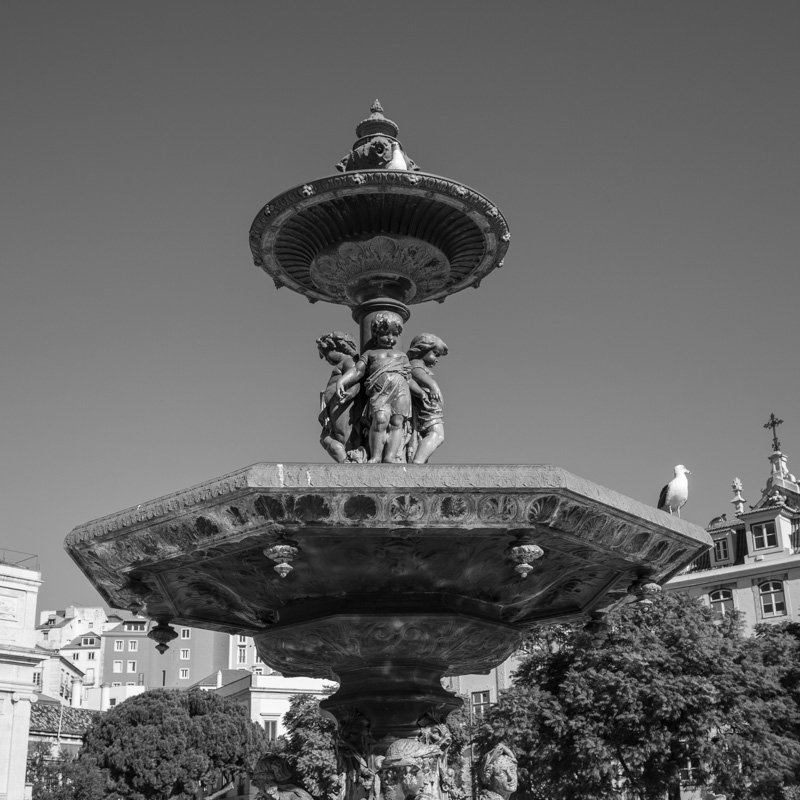
The square stands out for its long rectangular form and for the clarity with which it organises one of the central spaces of the Pombaline Baixa. Its present layout results from the post-earthquake regularisation and is framed by uniform urban fronts, now marked to the north by the National Theatre D. Maria II. At the centre rises the monument to Pedro IV, inaugurated on 29 April 1870. It stands on a granite base and a marble pedestal and culminates in the statue of the king atop a tall fluted column. At the base are four female allegorical figures representing Justice, Wisdom, Strength and Temperance. The monumental axis is reinforced by two symmetrical fountains, installed in 1889, with bronzed iron sculptures brought from Paris. Around them, the undulating Portuguese pavement and the visual opening towards streets such as Augusta, Betesga and Santa Justa help define the square as a place of passage, meeting and urban representation.
More context
The column of Pedro IV is the best place to begin reading the square, because it brings together political memory, urban composition and monumental scale. It is worth moving close to the pedestal to notice the four allegories and then stepping back far enough to understand how the column structures the entire space. The two fountains also deserve slow attention, not only because of their symmetrical position, but because of their bronzed iron figures and the constant presence of water, which animates the centre of Rossio. The undulating Portuguese pavement is another decisive feature, creating a very distinctive visual movement and tying the square to one of Lisbon’s most recognisable images. At the northern end, the National Theatre D. Maria II closes the perspective and recalls the nineteenth-century transformation of Rossio. Along the sides of the square, historic cafés, arcades and regular façades show that this remains a lived space rather than a purely monumental setting. Rossio is best understood by walking through it, first on axis and then in the round.
Gallery