Castelo de S. Jorge

Lisboa · Lisboa

Castelo de S. Jorge

CastleI a.C.Military Architecture
Rua de Santa Cruz do Castelo, 1100-129 Lisboa4.5 Rating · 99,89675 min

Rising from the highest point of old Lisbon, São Jorge Castle seems to gather almost the whole biography of the city into one place. The hill had been occupied since very early times, but the fortification we recognise today took shape in the Islamic period, as the last defensive stronghold of the citadel. After the conquest of 1147 by Afonso Henriques, the castle entered its brightest age: it became a royal palace, housed the court, the royal archive and major ceremonies, and from here the city’s rooftops, estuary and gateways could be watched over. When the royal residence moved down to the riverside, the complex lost its central role, was turned to military use and suffered after the 1755 earthquake, before being rediscovered in the great restoration campaigns of the twentieth century. Today, among walls, archaeological remains and the Camera Obscura in the Tower of Ulysses, it remains a rare place to understand Lisbon in layers, between stone, memory and horizon.

Why it matters

Standing on the highest hill in Lisbon’s historic centre, São Jorge Castle occupies a strategic site used by successive communities since the Iron Age. The fortification itself belongs to the Islamic period and took shape in the mid-eleventh century, when the alcáçova concentrated the city’s political and military power. After the Christian conquest of 1147 by King Afonso Henriques, the enclosure was adapted and enlarged. From the thirteenth century onwards it became a royal palace, receiving the court, the bishop and the kingdom’s archive in one of its towers. That central role lasted until the beginning of the sixteenth century, when King Manuel I transferred the royal residence to the riverside area. The castle then acquired a more military function, passed through several phases of alteration and was heavily affected by the 1755 earthquake. Classified as a National Monument in 1910, it underwent major restoration works between 1938 and 1940. Archaeological campaigns in the late twentieth century revealed once again the site’s deep historical layers.

Architecture and history

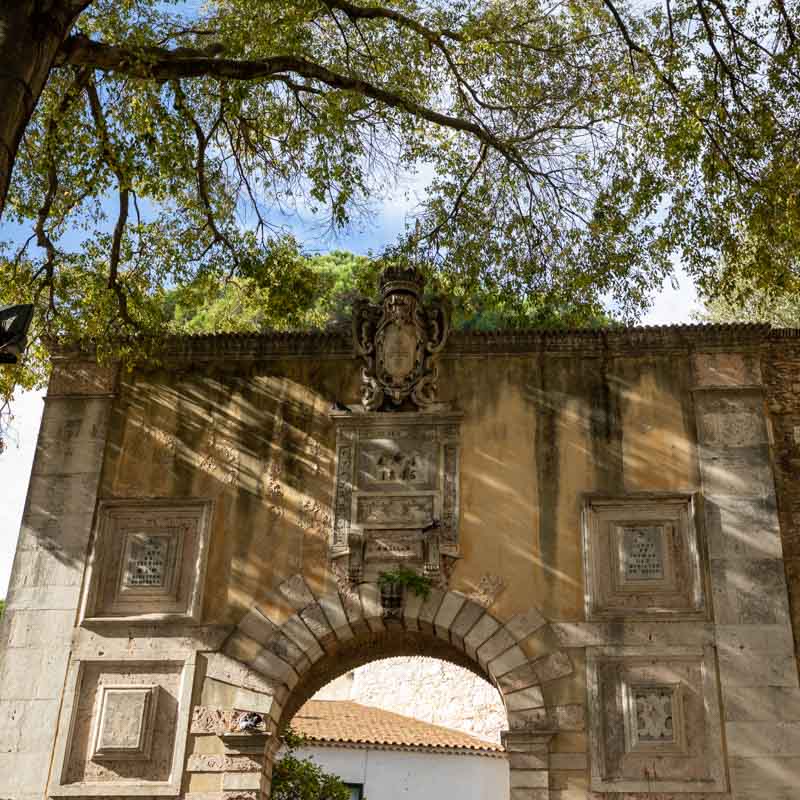
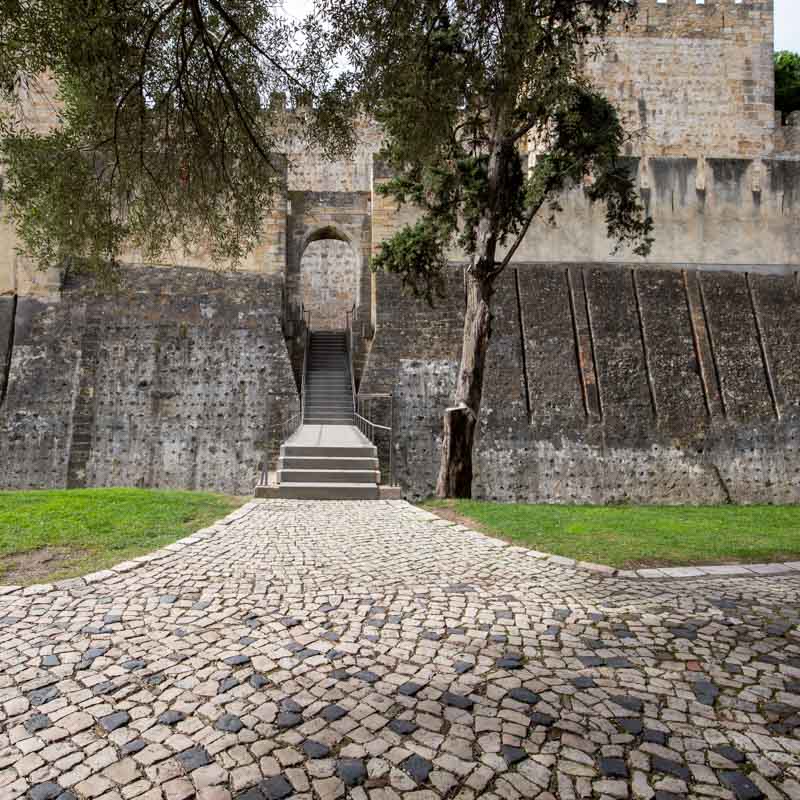
What can be seen today results from several building phases, yet the dominant configuration is that of a Gothic castle. The main enclosure has a quadrangular plan, a bent entrance and thick walls crowned with battlements. Around it stand 10 towers attached to the walls and a central tower on the wall that separates the two parade grounds, together with a barbican on the south and east sides, where the hill was more vulnerable. The complex includes wall walks, a moat and gates with defensive functions, among them the Gate of Treason, used as a discreet exit in times of siege. The Tower of Ulysses, above the main entrance, has become one of the monument’s most recognisable features. Around the castle survive the ruins of the Paço da Alcáçova, arranged through courtyards, stairways and balconies that recall the former royal residence. The scale of the whole is also striking because the monument covers about four hectares and brings together castle, walls, gardens, viewpoints and archaeological areas within a single heritage site.

More context

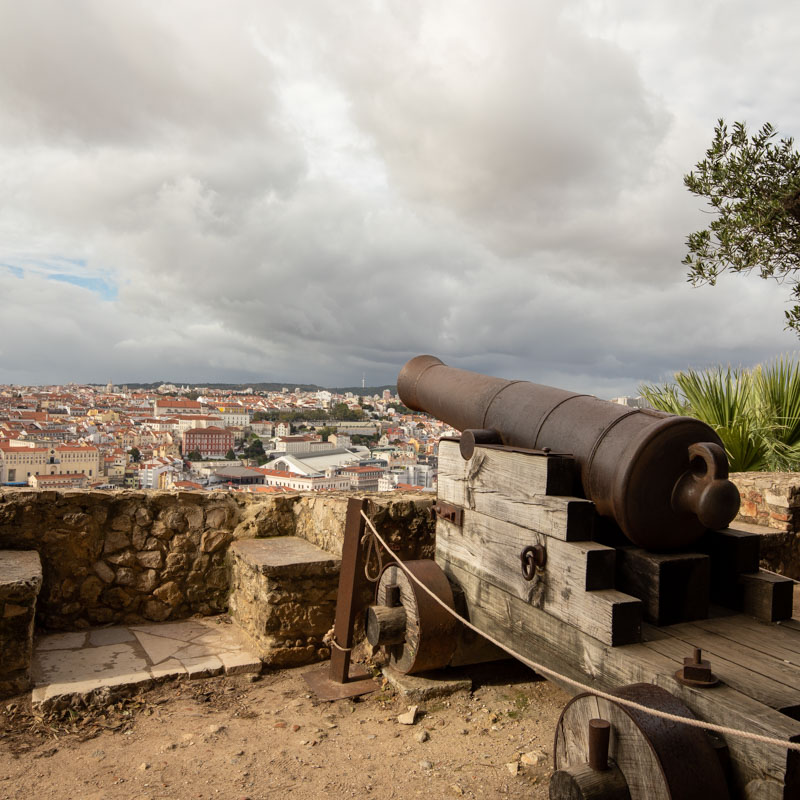
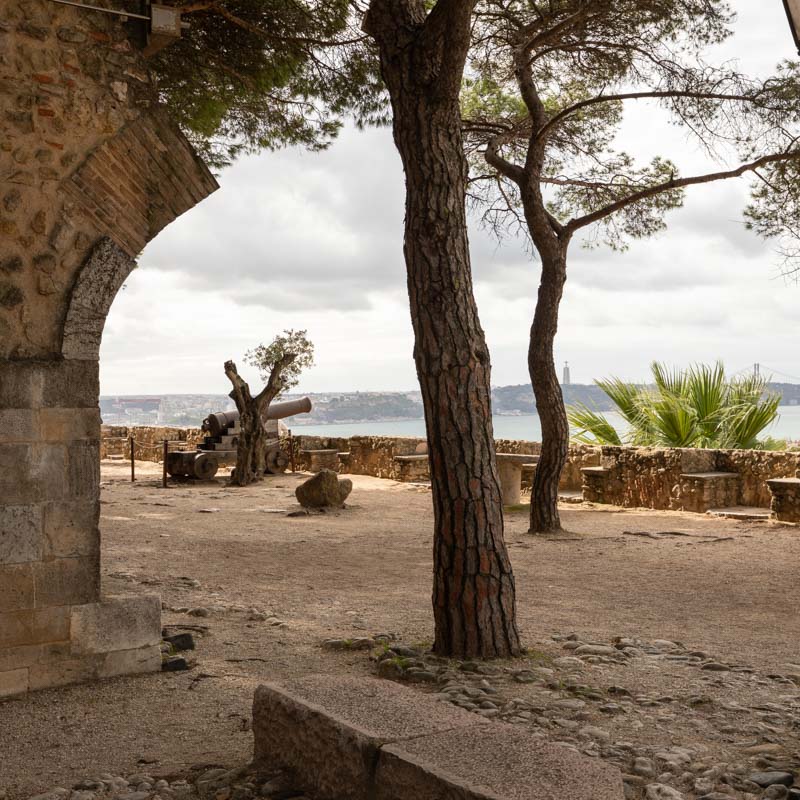
During a visit, the first highlight is the inner fortified enclosure and the wall walk, which allow you to read the monument’s defensive logic at close range and follow the relationship between towers, walls and gates. The Praça de Armas, on the southern side, opens out to a wide view over Lisbon and the Tagus, while Praça Nova, to the east, brings together very early building evidence and access to the Archaeological Site. There, visitors can see remains ranging from the earliest known occupations to the Islamic quarter of the eleventh century and to the ruins of a later residence destroyed by the 1755 earthquake. The Museum Centre also deserves attention, as the objects found in the alcáçova help explain the continuity of life on the hilltop across many centuries. In the Tower of Ulysses, the Camera Obscura offers a real-time view of the city through a system of lenses and mirrors with a 360-degree sweep. It is also worth pausing by the ruins of the former royal palace, because there the castle stops being only a fortress and reveals its palatial dimension.

Routes

Explore this place in a cultural route
View all Routes

Gallery

Castelo de S. Jorge 1
Castelo de S. Jorge 2
Castelo de S. Jorge 3
Castelo de S. Jorge 4
Castelo de S. Jorge 5

Nearby places

View all